Legally Right But Morally Wrong

Many years ago, I recommended a tax planning strategy  for the bank I was working for. I thought it was a very slick plan and it truly was when it came to avoiding ( as opposed to evading) taxes. Tax avoidance is legal. Tax evasion is a crime.   Unfortunately, the strategy  looked very, very wrong when it hit the newspapers. Without going into details I didn’t personally profit from this action but the bank did. Despite this, and with hindsight, it just wasn’t the right thing to do.  As one of the directors of the bank said to me, “Mark, it was legally right but morally wrong”. There are many examples of this principle. Think about slavery.  For centuries it was legal in the United States but certainly ethically repugnant. 

 I learned a very important lesson that day.  Thinking about how people will perceive an action has to be included in the consideration of the action. The same director was later the Vice-chair of the Board of Trustees of the University of Pennsylvania.  She was one of the first (if not the first) female graduates of the Penn Law School. For those not following the latest news, the President of Penn resigned and is going back to teach at this same law school. Liz Magilll  was forced from her job when she, after  repeated questioning would not say  if calls on campus for the genocide of Jews would violate the university’s  conduct policy. Relying on what sounded like a legalistic defense, MacGill insisted this was a matter of “context”.  Those of us that work in academia understand academic freedom and how important it and context is.  I have wondered what my old director (who sadly passed away before her time) would say about this situation.  I can almost hear her say, “ Penn was legally right, but morally wrong.”  Perhaps the presidents of other colleges should evaluate their positions under this same standard. 

A similar situation has come up in the Vatican.  Pope Francis recently met with the staff of the office of Vatican Auditor General. He asked that disclosure of financial impropriety be balanced by “merciful discretion”.  Anyone that knows anything about auditing understands  auditors have a fiduciary duty to their client, in this case the Pope.  Francis was absolutely correct in asking for  confidentiality.  On the other hand, Francis was supposed to “clean up” Vatican corruption during his pontificate. One must ask in the wake of the trial of Cardinal Becciu for financial malfeasance writ large on a massive scandal (one financial deal on its own was said to lose $150 million dollars) whether this is the morally right thing to do. Aren’t donors entitled to see how their gifts have been squandered? 

 I have always been deeply distrustful of the excuse of letting something illicit  pass “for the good of the organization”.  This is often only code for “someone needs to be protected.”  In the case of the Vatican, too much water has gone under the bridge, and it is time to realize “merciful discretion” is interpreted by many as continuing to cover up corruption. Sunshine is the best disinfectant for the  disease of corruption. It is odd to say, but even the Pope can be legally right and yet morally wrong. 

The Ethics Resource Council advocates the use of the PLUS model of ethical decision-making.  PLUS stands for:

Policies–does an action conform to  the organization’s policies and procedures?

Legal–Is the proposed action legal?

Universal–Does the proposed action conform to the organization’s values and universal principles?

Self–does this action comply with my own view of right or wrong? 

I have proposed a variation of this model I have called PLUMS.  In the modern world, one has to consider how other people will view a proposed action.  How will it be perceived by others when it hits the media?  It is often a good idea to just step back and think about how your action will look when it hits X, Youtube, or Facebook.  Maybe this pause for reflection  can prevent you from doing something that is legally right, but yet morally wrong. 
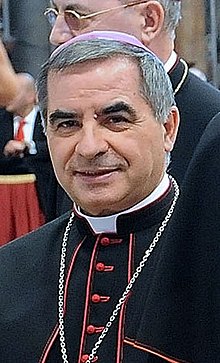
Cardinal Becciu in better days…

NFP Horseshoes–June 2020

Even though social distancing is still in effect in many Northeastern states, summer time has arrived.  As we approach the Summer Solstice, it is once again time to play  Not-For-Profit Horseshoes.  You remember the game.  A ringer counts for three points.  A double ringer is six.  Closest to the stake is one point, and a leaner is two. (The points for a learner is a local rule, not generally accepted!)

Here are some of the players and their scores in  recent  months:

Apple Computer–a  rare double ringer  for offering individualized lessons to college professors using the iPad and  Apple pencil. Professors such as myself have to spend a lot of time staying current with the subject material we teach let alone mastering new technology in the post-COVID world.  Apple has been making things a lot easier for everyone at colleges and universities, and our classes will be all the better for it.  The double ringer was awarded since Apple originally offered the free lessons through May, but has since extended the program through June.  This is a great example of corporate social responsibility. 

Rutgers University– My alma mater was nowhere near the stake in the  last issue of the alumni magazine. Rutgers was making a plea for donations since it expects its budget to be cut.  As I mentioned in previous blog entries, COVID-19 had hit not only NFP organizations but also state and local governments.  New Jersey funds about twenty percent of Rutgerts’ budget, and the university quite rightly expects there will be budget cuts.  In the same issue, Rutgers proudly talks about  rehiring Greg Schiano, a former head football coach both in the NFL and at Rutgers.  A quick internet search shows his salary is an eye popping  $4 million per year plus a king’s ransom for his  staff’s salary. I won’t go through the story of Schiano’s previous tenure as head football coach at Rutgers or the faculty’s reaction to his return, but it is  not a pretty one. As if this wasn’t enough, the magazine also  had a picture of a former president of Rutgers who is being paid a queen’s ransom for being a  professor after his troubled tenure as  president.  Such media sensitivity will undoubtedly increase alumni donations. Right. 

The Vatican–Have you heard the expression “close only counts in horseshoes and hand grenades?”  Unfortunately, the Vatican’s last pitch of the horseshoes isn’t even within the explosive radius of a hand grenade to the stake as it is dealing with the recent $225 million dollar plus London real estate scandal. This transaction was  initiated by the Office of the Papal Secretary of State, the Pope’s Prime Minister.  The sad part is the funds involved were purportedly generated by the annual Peter’s Pence collection, which the Vatican claims goes for humanitarian and mission work. It seems a couple of laymen will be tried in a Vatican court and that will be the end of that.  Of course, no senior Vatican officials were involved, right?  Hey, where is that final report on Cardinal McCarrick anyway?  You would think the need for financial transparency would have been learned long ago. It remains to be seen how the bad news that seems to be continually flowing from Rome will be taken by the faithful around the world. 

New Year Wishes

As the New Year approaches,  here is my “Top Five”  NFP wish list for 2020:

5.  The Vatican finally arrives at a workable and fiscally responsible structure.   You may protest the Catholic Church should not be considered here.  After  all, it is a sovereign entity and the leadership of one of the world’s largest religious denominations.  The current  Vatican organization is one Roman Emperors would be familiar with.  Granted it has proven resilient but that doesn’t necessarily mean effective.   Pope Francis continues to struggle with the Vatican “Deep State” as he tinkers with the levers of power in the Vatican.  I hope he figures it out this year. 

4. The City of Baltimore  implements an adequate system of internal control.  I have written about the City of Baltimore at length in this blog and via articles.  If fact, I am making the City of Baltimore a case study in my  Advanced Accounting class this year.  Students will study such things as the  lack of a control environment in the City, poor cyber-security, and the resignation of the city auditor.   Before anyone can say I am picking on Baltimore,  please allow me to point out Baltimore is not alone when it comes to a genuine lack of cyber security.  Many cities and  NFP entities were subject to cyber-attacks, most often with ransomware.

3. The Financial Accounting Standards Board focuses on the Little Guy. Yes, the FASB is an NFP organization.  I do not want to rehash the arguments the FASB has become the captive of major corporations.  However, in an  era of deregulation, perhaps the FASB should consider lightening the burden on private companies.  At the end of the day, small business has been an engine of economic growth.  The FASB should help that along. 

2.  Increased funding for Centers for Independent Living.  Yes, this is a little parochial, since I have been a CIL chairperson. Even though I am not associated with MOCEANS CIL anymore, I still see the good work this and other CILs have done.   Perhaps I am a little out of line here by quoting the Bible, but the words there ring so true at a CIL: “Go back and report… what you hear and see: The blind receive sight, the lame walk, the lepers are cleansed, the deaf hear…” (Matthew 11:15).

1. Increased charitable contribution limitations for federal income tax purposes.  Yes, I know the recent tax law changes have increased the limits to 60% of adjusted gross income for individuals.  It should be more and it should be an adjustment to adjusted gross income.  The government should encourage giving to the needy.  And yes, the corporate limitation should go up as well.  I don’t know if I  agreed  with  the politics of Paul Newman ( or even knew what his politics was) , but if his company wanted to give away 100% of its earnings to a deserving charity, I am all for that.  I buy Newman’s salad dressing to this day.

Crisis Management in an NFP

The Roman Catholic Diocese of Wheeling-Charleston, West Virginia recently announced its former bishop has been sanctioned by the Vatican.  The bishop was accused of sexual and financial misconduct. I will leave the sexual misconduct issues to others, but I do want to look at the financial misconduct issues purely from an NFP management perspective.

As part of the sanctions, the bishop was ordered not to live in the diocese.  Effectively, this means he will need to leave the State of West Virginia since the Wheeling-Charleston diocese encompasses the entire state. He has been prohibited from conducting public religious celebrations and will need to make restitution. [1]  That sounded good so far, but I was waiting for more.

Any organization facing a crisis needs to do three critical things:  fix the problem, prevent the problem from reoccurring, and be transparent.  While the Vatican fixed the problem by removing the bishop from office and instituting new internal controls in the diocese there was no discussion of how this particular person was selected to be a bishop, why the Vatican took so long to respond to warnings,[2] and what it is going to do to prevent this from happening again. In short, its response seemed dramatic but lacked essential elements of proper management. Perhaps the Vatican made nal improvements it did not announce.  Even so, that would fail the transparency requirement.  Constituencies are forgiving but they like to know this won’t reoccur.  The bishop’s successor has already been criticized as being a good man but not the right person for the job.[3]  I can only wish him luck.

Lest anyone should think this is an isolated incident, the Vatican also reinstalled a major archbishop (effectively equivalent to an Eastern Orthodox patriarch) in India who also had been accused of financial mismanagement.  In this case, the major archbishop entered into a real estate transaction that resulted in an inexplicable loss.  There were no reasons given what the result of the Vatican investigation was.  As a result, there have been major protests against his reinstatement. [4] All this could have been avoided if the Vatican followed simple principles of management. 

Not-For-Profits everywhere,  let this be a lesson. Remember:  fix the problem, make sure it doesn’t reoccur, and be transparent about how it occurred. 


[1] https://www.americamagazine.org/faith/2019/07/19/pope-francis-issues-disciplinary-measures-bishop-bransfield Accessed July 25,

[2] https://www.americamagazine.org/faith/2019/06/12/explainer-how-could-bishop-bransfield-misuse-funds-years-without-raising-red-flags  Accessed July 26, 2019

[3] http://whispersintheloggia.blogspot.com/ Accessed July 25, 2019

[4] https://cruxnow.com/church-in-asia/2019/07/24/catholic-priests-in-india-protest-cardinals-return/ Accessed July 21, 2019