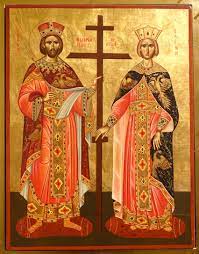
The Oxford English Dictionary defines a saint as a “person acknowledged as holy or virtuous and typically regarded as being in heaven after death.” Most religious people would not quibble with this definition. The devil is in the details though (pun intended). Sometimes there is a widely different interpretation of what a holy or virtuous life is. One example of that is Constantine the Great.
Constantine is regarded as a saint by the Orthodox and Eastern Catholic Churches and called an “Equal to the Apostles.” This accolade is awarded to those that are generally not bishops but having an outsized impact on the growth of Christianity similar to the first Apostles. His feast day and that of St. Helena is celebrated on May 21. Helena is associated with the finding of the True Cross, an expedition to the Holy Land sponsored by her son. Constantine called the first Ecumenical Council and was somewhat inaccurately described as the first Christian Roman Emperor. The Akathist to Constantine and Helen follows.
However, his legacy has been called into question by many others. Although the exact details are murky, Constantine was widely thought to have had his first son Crispus and his wife Fausta put to death in 326 A. D. for potential treason and palace intrigue. This was regarded by many as a brutal and savage act, unworthy of a saint. His defenders respond by saying Constantine surely acted as any other Roman Emperor, but he received Christian baptism on his deathbed in 337 A.D., ensuring his salvation.
Constantine also came under some intense criticism for his impact on the Church. Francis Hodur, the first prime bishop of the Polish National Catholic Church excoriated Constantine in his book the Apocalypse of the Twentieth Century. Hodur thought Constantine began harnessing the Church to the secular government, in effect corrupting it. He thought Constantine “involved himself in the internal affairs of the Church, playing the role of protector and temptor.” Of course, there is Hodur’s assessment of Constantine’s character: “…he was a skillful politician, a splendid general, a far sighted statesman, a sophisticated hypocrite and the murderer of his own wife Fausta and his son Crispus.” These are hardly recommendations for sainthood. While Constantine did not determine the outcome of the debates at the First Ecumenical Council, he did enforce them. To some, this was the beginning of the slippery slope towards repression by the Church. For obvious reasons, The PNCC does not celebrate St. Constantine.
Some other saints leave a legacy of divisiveness, meaning their universal veneration will never be achieved. For instance, had the Arian heresy developed into a sustainable competing Christianity, Arius would have no doubt been declared a saint by that group but not by Orthodox Christianity. Since Arianism faded away, its main proponent is now a footnote in religious history. A few more recent examples are: :
Alexis Toth was a Carpatho-Rusyn priest belonging to an Eastern Catholic Church in communion with Rome. He was scorned by the local Roman Catholic hierarchy when he arrived in the United States in 1889. Eventually, Toth left the Catholic Church to join what eventually came to be known as the Orthodox Church of America (OCA) . He is regarded as a saint by the OCA, but is certainly not accorded that status by either the Byzantine Catholic or Roman Catholic Churches. Toth is regarded as a schismatic by them as he is thought to have led 20,000 Catholics to the Orthodox Church. I highly doubt you will find a memorial to Alexis Toth in any Catholic Church. The Orthodox Akathist to St. Alexis Toth follows.
St. Josaphat is yet another example of how one group’s saint is not necessarily the second group’s saint. Josaphat was an Eastern Catholic Bishop and a member of the Basilian Order. His support for Catholicism resulted in his death in 1623. Josaphat was canonized by the Catholic Church in 1867. He is venerated for his devotion to Christian unity. In the Catholic Church but not so much in the Orthodox Church where he was fiercely resisted.
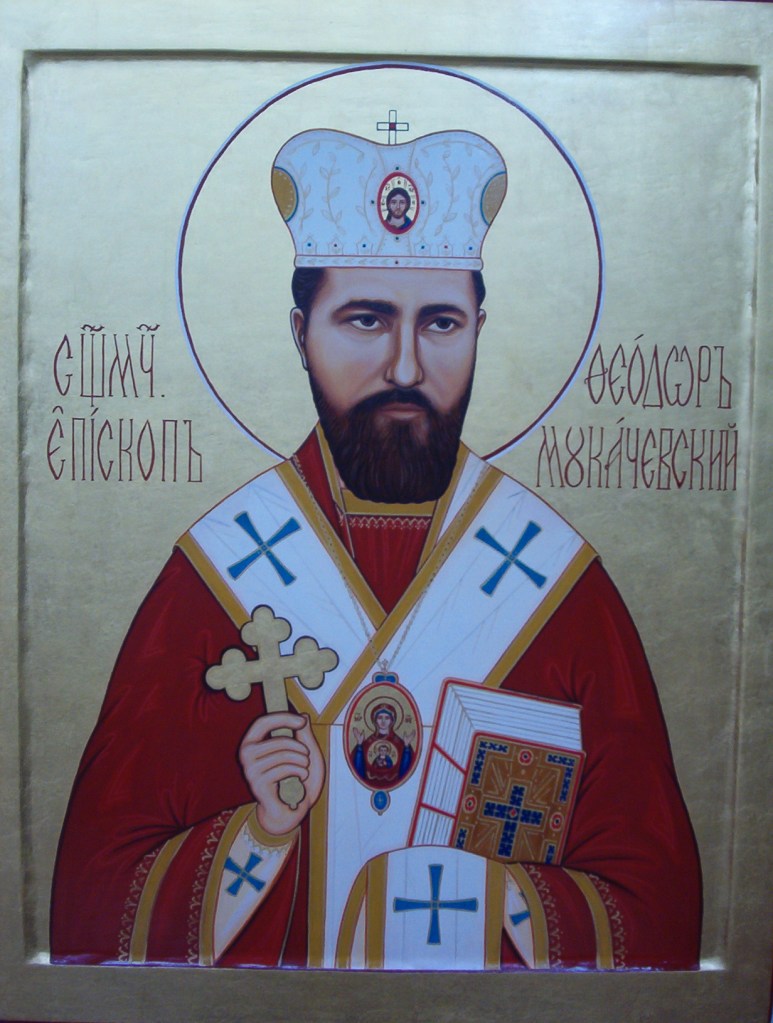
A third example of this is Theodore Romzha. Romzha was an Eastern Catholic Bishop who died in a very suspicious car accident in 1947 in the Western Ukraine. Romzha was eliminated at the behest of Nikita Khruschev, then responsible for that region of the USSR. Romzha’s church was forcibly incorporated into the Russian Orthodox Church. Pope John Paul II beatified Romzha in 2001, but the Orthodox will not be building any chapels to him in his honor for a long time.
 Mark Koscinski CPA D.Litt.